12.4K
Downloads
97
Episodes
I study animal behavior and I’ve had a bird’s eye view on how reconnecting with nature helps us live better lives. #WildConnection is a fun, engaging, and informative podcast hosted by me, Dr. Jennifer Verdolin, aka Dr Jen. No subject is off limits. You can expect a splash of humor and passionate conversations about humans, other animals, and how we are all connected. Episodes are released on Sundays. #WildConnectionPodcast is hosted by Podbean and available wherever you get your podcasts. Host: Jennifer Verdolin Twitter and Instagram @RealDrJen Get in touch and tell me what you want to hear more about info@jenniferverdolin.com
Episodes
Jun 6, 2021
Jun 6, 2021
1 hr 6 min
Welcome back everyone. This is episode 17 and this week I’ve got a special guest who is going to talk about something happening right now. You say cicada I say cicada and Dr Floyd Shockley says cover your ears because it's going to be LOUD.
Right here in the United States, primarily along the eastern seaboard it was a magical time beginning around mid-May. Brood 10 was emerging and this only happens for this group every 17 years. That means this generation was laid in 2004! The next generation of brood 10 won’t happen until 2038! Even though I recorded this episode a few weeks ago they are still around making their final gasp of air before all of them die hopeful the next generation will survive and carry the torch. These periodical cicadas are unique to the eastern U.S. This week's guest is entomologist Dr. Floyd Shockley, who is the Collections Manager for the Department of Entomology at the Smithsonian National Museum of Natural History. Him and I talk all about these true bugs and the importance of museum collections. You can follow him on Twitter @Beetle_Guy
And you can connect with the museum @NMNH
If you want to hear one of the three species of Brood X sing their love song check out this link.
One of many cookbooks is the Cicada Cookbook and you can find it on Amazon.
If you are digging the show subscribe and share it so others can enjoy it too. You can follow the show on Itunes, Google Play, or wherever you listen to podcasts. Also follow the show on Twitter: @WildConnectPod
You can also follow me on
Twitter: @realdrjen
Instagram: @readrjen
Facebook https://www.facebook.com/RealDrJen
There is also a YouTube Channel where you can find a range of videos, some of them tied to podcast episodes. More are on the way so subscribe to Wild Connection TV
May 30, 2021
May 30, 2021
58 min
Welcome back to Wild Connection: The Podcast. I’m your host Dr. Jen and this week I am back with Dr. Jeffrey Lockwood, Prof of Natural Sciences and Humanities at the University of Wyoming. He’s also a librettist and This week we are talking all about locusts. From the Pharaohs of Egypt to the cattle farmers of the present, locusts have a pretty bad reputation. We’re talking a plague of biblical proportion and its happening right now.
If you want to eat some locusts here is a good recipe:
https://www.greenprophet.com/2013/03/feasting-on-locusts-a-recipe-from-moshe-bassons-kitchen/
You can keep up with Dr. Lockwood via his website
https://www.jeffreylockwoodauthor.com
On Twitter: @J_A_Lockwood
If you want to watch the Opera Locust you can find it here:
Scene I https://youtu.be/L_4xzj7gAjA
Scene II https://youtu.be/KyK4jQwcfcw
Scene III https://youtu.be/tuq1U815e6Q
And to buy a copy of Locust (the story of the Rocky Mountain locust): https://www.amazon.com/Locust-Devastating-Mysterious-Disappearance-American/dp/0465041671.
If you are digging the show subscribe and share it so others can enjoy it too. You can follow the show on Itunes, Google Play, or wherever you listen to podcasts. Also follow the show on Twitter: @wildconnectpod
You can also follow me on
Twitter: @realdrjen
Instagram: @readrjen
Facebook https://www.facebook.com/RealDrJen
There is also a YouTube Channel where you can find a range of videos, some of them tied to podcast episodes. More are on the way so subscribe to Wild Connection TV
May 23, 2021
May 23, 2021
1 hr 2 min
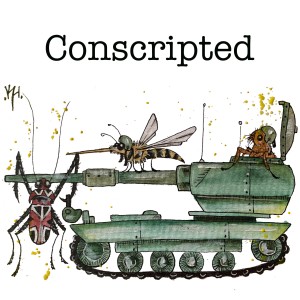
Today's episode is all about insects and is a theme for the next 3 weeks. I discovered Dr. Jeff Lockwood, a Professor of Natural Science and the Humanities at the university of Wyoming, when I was doing research for episode 9, Love is a Battlefield, I came across his work sharing how insects have been used as weapons in human warfare. That stopped me in my tracks and I knew I had to dig deeper. After much digging and reading it was clear that I needed two episodes to cover this special topic. This is Part I. From direct attacks and using insects to cause disease to indirect attacks by destroying agricultural crops and starving your opponent to death, humans have an uneasy and well ugly history with some insects. Join us as we talk about his book Six-legged Soldiers .
You can keep up with scientist, author, and librettist Dr. Jeffrey Lockwood by visiting his website at
https://www.jeffreylockwoodauthor.com
Twitter: @J_A_Lockwood
I was inspired by his book to design a cover for this episode. As always the talented Krys Hookah brought my vision to life with this amazing piece. You can find more of her work at her store You can also folder her on Instagram @KrysHookuh
May 16, 2021
May 16, 2021
1 hr 7 min
Today's episode tackles a BIG question: What is cognition and consciousness and do other species have it?
That's not all though, my guest Dr. Kristy Biolsi, Associate Professor of Psychology at St. Francis College (@SFCNY) in Brooklyn Heights NY and co-founder and Director of the Center for the Study of Pinniped Ecology and Cognition (C-SPEC) talks to us about what she's discovering about the cognitive abilities of seals as well as why seals are back in New York City waterways.
During this podcast we also chat about safe ways to enjoy seals and what you can do to help.
You can find out more information about the Riverhead Foundation here: https://www.longislandaquarium.com/riverhead-foundation-rescue-center/
and go on a seal walk if you are in the NY area with CRESLI. Check their website https://www.cresli.org/seals/
for details.
If you're enjoying the show subscribe and share it so others can enjoy it too. You can follow the show on Itunes, Google Play, or wherever you listen to podcasts. Also follow the show on Twitter: @WildConnectPod
You can also follow me on
Twitter: @realdrjen
Instagram: @readrjen
Facebook https://www.facebook.com/RealDrJen
There is also a YouTube Channel where you can find a range of videos, some of them tied to podcast episodes. More are on the way so subscribe to Wild Connection TV
May 9, 2021
May 9, 2021
1 hr 11 min
This week its all about volcanoes. And not just about eruptions, of which there have been two significant ones recently. There is so much interesting history surrounding how people cope and live around such a potentially dangerous natural phenomenon and the societal factors that shape who is impacted, who recovers and who doesn’t when there is an eruption. To tell us about all of that is a brilliant scientist, Dr. Jazmin Scarlett.
You can keep up with all the amazing work Dr. Jazmin Scarlett is doing by following her on Twitter : @scarlett_jazmin
Or by subscribing to her blog: https://phdvolcanology.wordpress.com
If you want to donate this link provides you with details on how you can help:
(https://twitter.com/djimeshaprince/status/1381016213728460805?s=21)
If you are enjoying the show subscribe and share it so others can enjoy it too. You can follow the show on Itunes, Google Play, or wherever you listen to podcasts. Also follow the show on Twitter: @WildConnectPod
You can also follow me on
Twitter: @realdrjen
Instagram: @readrjen
Facebook https://www.facebook.com/RealDrJen
There is also a YouTube Channel where you can find a range of videos, some of them tied to podcast episodes. More are on the way so subscribe to Wild Connection TV
according to NASA there are currently 45 active volcanoes on Earth at the moment and you can see La Soufrieres activity and others here: https://earthobservatory.nasa.gov/images/148190/tracking-la-soufrieres-plume
Tune in next week for my conversation with Dr. Kristy Biolsi where we try to determine what is consciousness and do other species have it?
May 2, 2021
May 2, 2021
1 hr 26 min
Welcome back everyone. This week is Part 2 of my interview with geographer Dr. Jacob Shell. He specializes in human transportation networks that rely on animals. His book, Giants of the Monsoon forest: Living and Working with Elephants, is a thought provoking read. If you haven’t heard part one, please do listen as that’s where we talk about the history of humans using elephants, talk about why Asian elephants are still used while African elephants are not, and where he describes how new elephants are captured. We left off on the cusp of talking about how continued use of elephants helps with conservation. In this episode we shift toward exploring how the humans and elephants interact in modern Myanmar and what this means for the future of the Asian elephant.
Dr. Jacob Shell is a professor of geography and urban studies at Temple University. He writes about transport animals, maps, and transient landscapes.
You can connect with him on Twitter @JacobAShell and he has a marvelous visual website
https://jacobshell.carbonmade.com/
If you are digging the show subscribe and share it so others can enjoy it too. You can follow the show on Itunes, Google Play, or wherever you listen to podcasts. Also follow the show on Twitter: @WildConnectPod
You can also follow me on
Twitter: @realdrjen
Instagram: @readrjen
Facebook https://www.facebook.com/RealDrJen
There is also a YouTube Channel where you can find a range of videos, some of them tied to podcast episodes. More are on the way so subscribe to Wild Connection TV
Apr 25, 2021
Apr 25, 2021
49 min
Hi everyone. This week is Part I of a 2 part interview I had with Dr. Jacob Shell is a geographer that specializes in transportation networks and the interface between humans and other animals when it comes to getting around. We talk about one of his books, Giants of the Monsoon Forest: Living and Working with Elephants. His work and this book really examines so many aspects of how connected we all are that we just couldn’t cover it all in one podcast. When we consider how we use other species to meet our needs, one has to ask, are we and can we also meet the needs of those species that we depend on? How can we ensure their autonomy and independence in a rapidly a world we dominate?
Dr. Jacob Shell is a professor of geography and urban studies at Temple University. He writes about transport animals, maps, and transient landscapes.
You can connect with him on Twitter @JacobAShell and he has a marvelous visual website
https://jacobshell.carbonmade.com/
You can also see more of his work here. His book, Giants of the Monsoon Forest: Living and Working with Elephants is available on Amazon and other sellers. It is fascinating and I recommend it highly.
If you are digging the show subscribe and share it so others can enjoy it too. You can follow the show on Itunes, Google Play, or wherever you listen to podcasts. Also follow the show on Twitter: @WildConnectPod
You can also follow me on
Twitter: @realdrjen
Instagram: @readrjen
Facebook https://www.facebook.com/RealDrJen
There is also a YouTube Channel where you can find a range of videos, some of them tied to podcast episodes. More are on the way so subscribe to Wild Connection TV
Apr 21, 2021
Apr 21, 2021
1 hr 17 min
It is Earth Day tomorrow April 22, so this episode is coming out a little late. As a celebration of Earth Day, my guest Dr. Gary Shapiro and I talk about orangutans, the not for profit that he co-founded with his wife, and how becoming aware and researching the nuances of the difficult ecological problems we are facing is something we should all commit to this Earth Day 2021.
To learn more about the organization, Orang Utan Republic visit their website at https://www.orangutanrepublik.org
You can also follow them on Twitter @OURF and Facebook at https://www.facebook.com/OrangUtanRepublik
If you are digging the show subscribe and share it so others can enjoy it too. You can follow the show on Itunes, Google Play, or wherever you listen to podcasts. Also follow the show on Twitter: @WildConnectPod
You can also follow me on
Twitter: @realdrjen
Instagram: @readrjen
Facebook https://www.facebook.com/RealDrJen
There is also a YouTube Channel where you can find a range of videos, some of them tied to podcast episodes. More are on the way so subscribe to Wild Connection TV
Apr 11, 2021
Apr 11, 2021
39 min
Today I am talking about insects, their weapons, how they are used in love and war, and how some scientists curious about why insects have elaborate weaponry use a bit of creativity to get some answers. One of those scientists, Dr. Zach Emberts is my guest today. He studies animal behavior and the evolution of anima weapons with a focus on insects.
Dr. Emberts is a National Science Foundation Postdoctoral Research Fellow in the Department of Ecology and Evolutionary Biology at the University of Arizona. The research we are talking about today was done in collaboration with his postdoctoral advisor, Dr. John Weins. You can learn more about the Weins lab here and follow Zach Emberts on Twitter @ZachEmberts
A highlight of the episode is where Zach talks about the creative problem solving needed to design the body armour used in the fighting experiments.

And here is a video showing just how these critters fight and wrestle.
If you are digging the show subscribe and share it so others can enjoy it too. You can follow the show on Itunes, Google Play, or wherever you listen to podcasts. Also follow the show on Twitter: @WildConnectPod
You can also follow me on
Twitter: @realdrjen
Instagram: @readrjen
Facebook https://www.facebook.com/RealDrJen
Apr 4, 2021
Apr 4, 2021
1 hr 9 min
In this episode I talk with Dr. Adam- Hartstone-Rose whose bustling functional morphology and comparative anatomy lab at NCSU is not just giving us insights into the relationship between jaws and diet but is a place of mentoring for the next generation of scientists.
If you are digging the show subscribe and share it so others can enjoy it too. You can follow the show on Itunes, Google Play, or wherever you listen to podcasts. Also follow the show on Twitter: @WildConnectPod
You can also follow me on
Twitter: @realdrjen
Instagram: @readrjen
Facebook https://www.facebook.com/RealDrJen
There is also a YouTube Channel where you can find a range of videos, some of them tied to podcast episodes. More are on the way so subscribe to Wild Connection TV
To find out more about Dr. Adam Hartstone-Rose and his lab visit his website here: https://hartstoneroselab.wordpress.ncsu.edu and follow him on Twitter @GreaterSkulls
Here are some of the places and organizations we talked about in this episode:
American Museum of Natural History: https://www.amnh.org
Carolina Tiger Rescue: https://carolinatigerrescue.org
Duke Lemur Center: https://lemur.duke.edu
If you like the show theme music that's thanks to George Nardo of Luna Recording Studios in Tucson AZ. https://lunarecording.com